Your cart is currently empty!


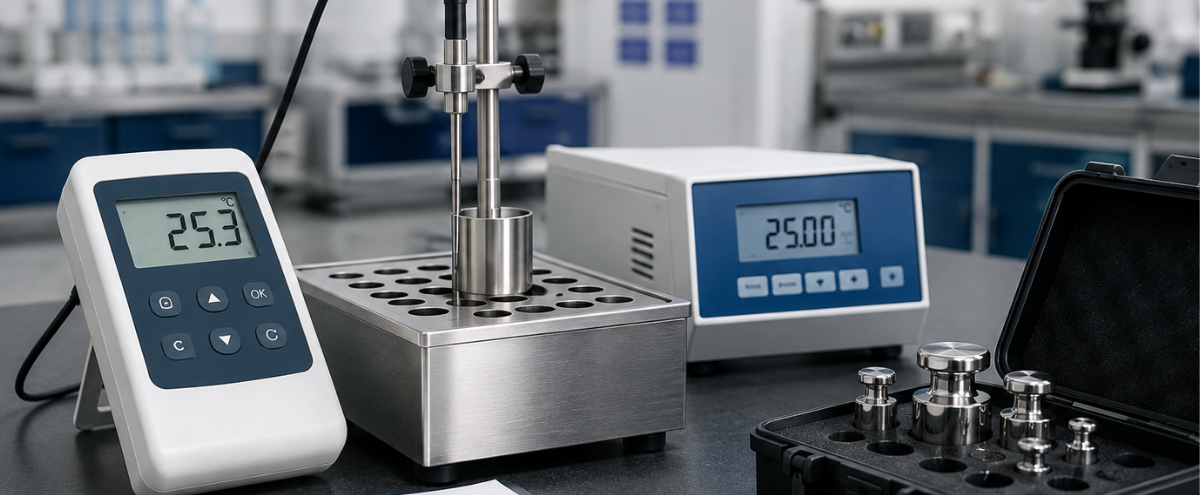
This guide explains how NABL Calibration Services elucidate the process of measurement improvement through the detection of instrument error, establishment of traceability, and improvement of measurement quality for temperature, humidity, and pressure.
A temperature reading may look accurate on your screen, but can you trust the instrument producing it? For pharmaceutical manufacturers, cold-chain logistics companies, food businesses, laboratories, and healthcare facilities, reliable measurements are essential. Inaccuracies in temperature, humidity, and pressure readings can compromise an organization’s quality and compliance records.
NABL Calibration Services provide assurance by means of a calibration process through which one can assess how closely a measuring instrument is aligned with a suitable reference. NABL accredits calibration laboratories that conform to ISO/IEC 17025.
In this guide, we’ll explain how an Affordable NABL-accredited calibration service can help identify measurement deviations, support traceability, and improve confidence in temperature monitoring data.
NABL, the National Accreditation Board for Testing and Calibration Laboratories, grants accreditation to calibration laboratories under ISO/IEC 17025. The standard outlines the competency of all testing and calibration laboratories.
In simpler terms, to calibrate is to check the performance of a given instrument with respect to its appropriate reference. It does not imply that a given device will provide perfect measurements. It provides documented information on the measurement performance of the instrument.
NABL Accredited Calibration is particularly useful when your business needs dependable records for quality control, technical review, or regulatory work.
Here’s the thing: even a good sensor can show measurement drift over time. Regular calibration can help identify that deviation before you rely on questionable readings.
A professional NABL Calibration Service can help you:
NABL guidance states that calibration certificates from accredited calibration laboratories include measurement uncertainty and information on how measurements are metrologically traceable.
For your quality team, what this really means is simple: you have better information when deciding whether an instrument remains suitable for its intended use.
Temperature monitoring plays a major role in cold-chain operations. WHO states that temperature mapping and monitoring are integral to appropriate pharmaceutical storage conditions. Cold rooms, freezers, refrigerators, storage units, and other devices and equipment associated with the cold chain are covered by the WHO’s 2026 guidance.
Your equipment may consist of:
According to the WHO, thermometers, temperature recorders and loggers, equipment monitors, and event loggers are all included in a cold-chain monitoring device.
This is why the importance of Temperature Calibration Services cannot be overlooked. Should a monitoring device provide an inaccurate reading, it is most probable that the records will not accurately reflect the temperature of the environment surrounding temperature-sensitive goods.
A Traceable calibration certificate is a record of the details pertaining to the calibration of an instrument. Based on the calibration activity, the certificate may include the identification of the instrument, results, uncertainty, reference standards, and traceability.
Before accepting a certificate, check:
| What to Check | Why It Matters |
|---|---|
| Instrument ID and serial number | Confirms which device was calibrated |
| Measurement parameter | Confirms what was tested |
| Calibration range | Shows the applicable measurement range |
| Results and deviation | Shows instrument performance |
| Measurement uncertainty | Helps interpret the reported result |
| Traceability information | Shows the measurement reference chain |
| Calibration date | Helps maintain your records |
These two services are useful, but they answer different questions.
| Calibration | Thermal Mapping |
|---|---|
| Checks instrument measurement performance | Shows temperature distribution |
| Applies to measuring devices | Applies to storage or transport spaces |
| Produces calibration results | Produces a temperature profile |
| Supports confidence in measurements | Helps identify temperature variation |
For example, Tempnote provides NABL calibration services for temperature, humidity, pressure, and other parameters. It also provides cold-room and reefer-vehicle thermal mapping services.
WHO describes temperature mapping as the process of recording and mapping temperatures across three-dimensional storage spaces.
Before selecting Calibration Services India, do not look only for the NABL name. Check the laboratory’s actual accreditation scope.
Confirm that it covers:
This small check can save you from choosing a laboratory that is accredited but does not cover the exact calibration your business requires.
Suppose your pharmaceutical facility uses temperature data loggers inside a cold room. If one logger starts giving readings that are out of expectation, the quality team can send the logger for the sensor accuracy test and calibration. Based on the results, the performance of the logger can be evaluated, and the next steps can be implemented.
This illustrates how calibration and thermal mapping complement each other. The former is done for the measuring device, and the latter is done for the storage spaces.
Reliable measurement data allows informed decisions. NABL Calibration Services helps businesses measure the performance of their instruments, maintain traceability, and document uncertainty while helping to support quality assurance and compliance.
Tempnote partners with NABL-accredited channel partners and provides calibrations for temperature, humidity, pressure, and other parameters.
Before your next quality review, review your instruments, calibration records, accreditation requirements, and the scope of your calibration to see if there is an opportunity for improvement of your measurements relating to your operations.
NABL calibration is calibration performed by a laboratory accredited by NABL within its defined scope. NABL accredits calibration laboratories under ISO/IEC 17025.
This type of calibration identifies measurement differences and provides the results of calibration, uncertainty, and traceability.
Sensors and data loggers are used to measure temperatures of products that can be adversely affected by temperature. Calibration determines if the measurements of such devices are still acceptable.
It is a calibration record that provides measurement results and relevant information showing how those results are linked through an appropriate metrological traceability chain.
Check the laboratory’s NABL accreditation scope and confirm that it covers your instrument, measurement parameter, and required range before placing an order.