Your cart is currently empty!


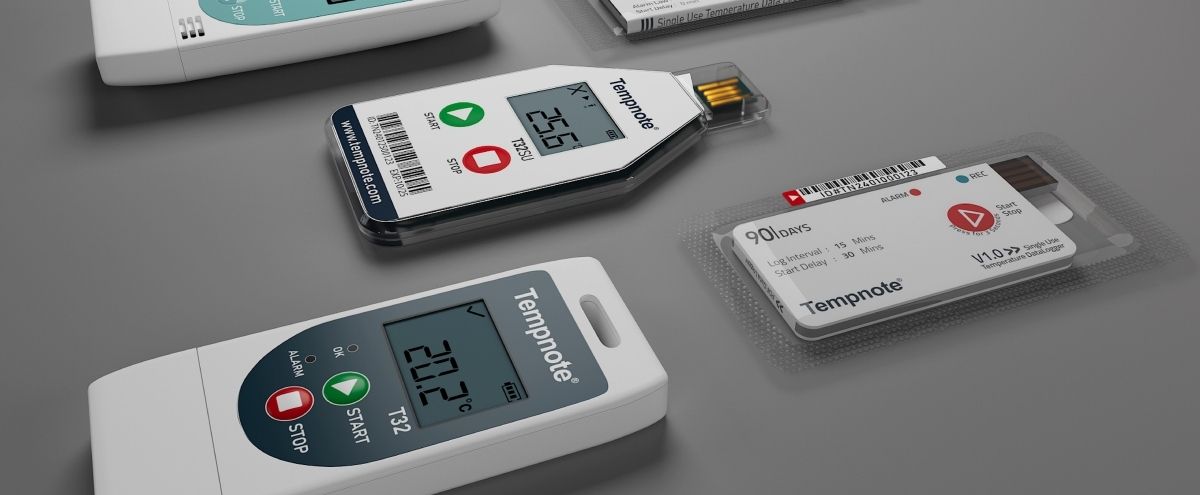
In this blog, you will learn about the role of USB loggers, the differences between USB loggers and real-time loggers, and the right ways to use USB loggers.
You pack a pallet of vaccines, insulin, or frozen fish. The truck pulls away. Then what? Most of the trip happens where you can’t see it.
Here’s the thing: if you can’t prove the temperature stayed in the acceptable range, you can’t prove the product is safe. A USB temperature data logger solves that. It is small, simple, and never takes a break. Let’s get into the details.
A USB temperature data logger is a small, battery-powered device that records temperature at periodic intervals. Upon completion of a trip, the user plugs the logger into a computer, and the software displays a report in CSV or PDF format.
It’s also called a USB temperature logger, USB temperature recorder, or USB temperature monitoring device. They’re all the same thing.
Two words to add to your logistics vocabulary:
Let’s look at Tempnote T32SU as an example. It can record temperatures from -30 to 70°C with an accuracy of ±0.5°C and has a memory of 32,000 readings. You can set the recording interval anywhere from 10 seconds to 18 hours. It is rated IP65, which means it is dust-tight and splash-proof.
According to our own calculations, at a 10-second recording interval, it can store about 3.7 days’ worth of data. At a 5-minute recording interval, it can store 111 days’ worth of data. Choose your recording interval to match the shipment length.
In a 2013 WHO Bulletin study, electronic temperature recorders and vaccine vials were packed in boxes with routine supplies and shipped to 10 different Indian states.
During the storage period at lower-level health facilities, the boxes spent 14.7% of the time at temperatures above 8°C and 10.5% of the time at temperatures below 0°C. In the final shake tests, approximately two-thirds of the vaccine vials showed signs of freezing.
In this case, it means trouble is found at every step, and cold chain damage often goes undetected because people look for heat. A caveat: The study is old, it focused on vaccines in India, and the shake test is not a validated gold standard. That said, the takeaway here is applicable to any cold chain.
Here’s a hypothetical example. A pallet of insulin sits on a hot ramp for three hours. Without a log, nobody owns the loss. With one, you see the exact window and fix that step.
| Question | USB logger (T32SU) | Real-time logger (Frigga V5D) |
|---|---|---|
| Can you see data mid-trip? | No | Yes, via web or mobile app |
| Do you get alerts as it happens? | No | Yes |
| How do you read the data? | Plug in, download PDF or CSV | Online dashboard |
| Range and runtime | -30°C to +70°C, 300+ days | -20°C to +70°C, 60 days |
| Best for | Routine shipments, proof and audits | Cargo you can’t afford to lose |
Our take: use USB loggers on every shipment for the record. Add a Frigga V5D when you need to act before the cargo arrives.
Try this at your dock: the 60-second receiving check. Before you sign, check the alarm status and scan the graph for flat stretches outside range. Then accept, hold, or reject.
Cold chain safety comes down to evidence. A USB temperature data logger gives you that evidence for every trip, at a low cost. It won’t warn you at the moment, so match it to the risk and add real-time tracking where it counts.
Ready to pick one?
See the USB temperature data logger range, check the T32SU sample report, or talk to the Tempnote team through the contact page.
What does a USB temperature data logger do?
It records temperature at set intervals and stores the readings. You plug it into a computer to download a report.
How does a temperature data logger work?
A sensor takes readings and saves them with timestamps. At the end of the trip, software turns them into a graph and a PDF or CSV file.
How accurate are USB temperature loggers?
It depends on the model. The T32SU is rated ±0.5°C across -30°C to +70°C, and a calibration certificate backs that up.
Can a USB temperature logger send alerts?
No. It stores data for download after the trip. For live alerts, use a real-time logger.
Do USB loggers meet cold chain compliance rules?
Many carry certifications such as EN12830 and CE. Check each model’s certificates against your own GDP and carrier rules.
