Your cart is currently empty!


This guide explains how Cold Chain Temperature Data Loggers work, how they detect temperature excursions, and why recorded data is important for pharmaceuticals, vaccines, food, laboratories, and other sensitive products.
When you ship temperature-sensitive products, knowing the temperature at the start and end of transit is not enough. Temperature-controlled pharmaceuticals, vaccines, biologics, food, and other products in the cold chain are at risk for temperature exposures when they are stored, transferred, and moved. Temperature excursions, which may jeopardize quality and safety, may go unnoticed.
The thing is that a Cold Chain Data Logger is vital. Unlike a regular thermometer that displays a current reading, a data logger stores temperature as data at the intervals that you set. From this, the data logger can show the duration and time of the temperature change, and whether or not there was a temperature spike that requires evaluation. Tempnote offers USB, single-use, reusable, and real-time monitoring solutions designed for cold-chain applications.
A data logger does not keep a shipment cold. Proper handling, refrigeration, and insulation do that. The logger gives you the temperature history and visibility needed to identify problems, support quality checks, and make informed decisions about your products.
This guide will help you understand how a Temperature Data Logger for Cold Chain works and how temperature excursions can be identified, understand when real-time monitoring or USB data loggers can be a better fit based on your operation, and how temperature data can improve the quality of your products.
A Cold Chain Data Logger is an electronic logging device that measures and stores temperature readings during product storage or transportation. Unlike a thermometer, it provides a temperature history.
The World Health Organization (WHO) classifies data loggers within temperature monitoring devices employed along the whole length of the cold chain. Its guidance also distinguishes data loggers from more advanced remote monitoring systems, showing that different devices serve different operational needs.
These devices are useful for pharmaceuticals, vaccines, biologics, food, laboratory materials, and refrigerated shipments.
For example, a professional Cold Chain Monitoring can record conditions while a pharmaceutical shipment moves from a warehouse to an airport, then to a distributor.
The logger takes readings according to a programmed recording interval. This gives your team a history rather than a single temperature check.
A data logger will measure high and low temperatures, and some will even measure out-of-range temperatures and/or alert you when limits are exceeded.
Suppose a shipment arrives at the correct temperature. That does not prove it stayed within range throughout transit. Historical readings can show when a change occurred and how long it lasted.
Wireless systems give visibility and alerts to temperature-out-of-range conditions while the shipment is in transit.
Temperature-sensitive products can have specific storage requirements. Vaccines are a clear example. The CDC recommends a digital data logger for vaccine temperature monitoring because it can provide continuous records and show how long temperatures have remained outside the recommended range.
The important point is that not every excursion automatically means a product is unusable. Ensure that your quality team evaluates the recorded conditions against the product’s approved storage requirements.
Common causes include:
| Feature | USB Logger | Wireless Logger |
|---|---|---|
| Data access | Retrieved from device | Sent remotely |
| Main benefit | Simple data review | Remote visibility |
| Useful for | Shipment records | Active transit monitoring |
| Alerts | Device-dependent | Often available in real time |
A USB Cold Chain Data Logger is suitable if your team only needs a record after transport. A wireless logger may be more appropriate if you need data-logged alerts during transport.
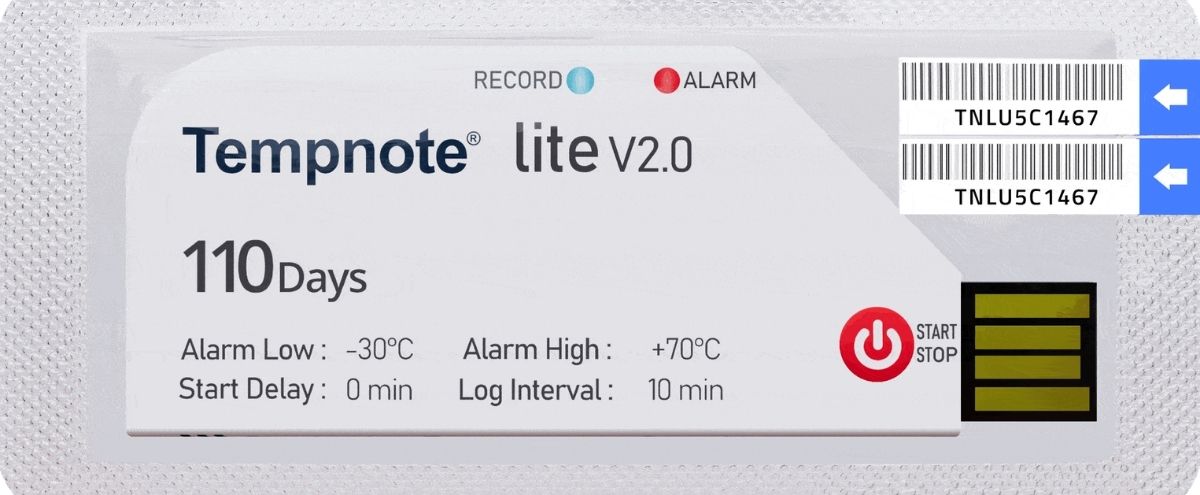
For example, Tempnote’s T32SU records temperatures from -30°C to +70°C, stores data values of up to 32,000, can be programmed to record data at user-defined intervals, has high and low alarms, and captures data in PDF and CSV reports. It also has the certifications EN12830, CE, and RTCA-DO160G.
Managing the cold chain is not just about controlling temperatures. It is about recording temperatures in order to explain events that may be helpful to your team.
WHO’s 2026 cold-chain temperature mapping tool states that temperature mapping and monitoring are critical when maintaining the required temperature for the storage and handling of pharmaceutical and vaccine products.
This data can help with:
In 2026, this data can assist the marketing and communications teams in providing accurate customer education. Instead of using broad statements with regard to the safety of the product, the content team can explain the product monitoring process and provide the customer with documented temperature records.
Let’s say that there is a shipment of pharmaceuticals that was dispatched from a cold storage facility to a distributor. Prior to dispatch, your team activates the logger. Due to delays during transport, the temperature in the shipment begins to rise.
The logger captures the data. When the shipment reaches its destination, the quality team will have access to the temperature history and can identify the time period and the extent of the excursion to follow the company’s approved assessment process.
A Cold Chain Data Logger cannot replace refrigeration, insulation, proper handling, or trained staff. Its role is to measure and record the conditions your products experience.
If you need a Cold Chain Monitoring Data Logger for pharmaceuticals, food, laboratories, or logistics, explore Tempnote’s range of single-use, multi-use, dry-ice, and real-time monitoring options.
This is an electronic device that captures and retains temperature data over time in the course of transporting and/or storing a product that requires temperature control.
A cold chain data logger is programmed to take temperature readings at certain time intervals. These readings can then be accessed or monitored (with the right equipment) at a later time.
Data loggers create an important record of the vaccine’s temperature. This record can determine if the recommended storage temperature was maintained.
The majority of USB data loggers require you to manually retrieve the data. Wireless data loggers, on the other hand, can send data across a network and even generate alerts.
No, by design, data loggers do not control the temperature. Clean cold chain practices are necessary to maintain the recommended storage temperature.