Your cart is currently empty!


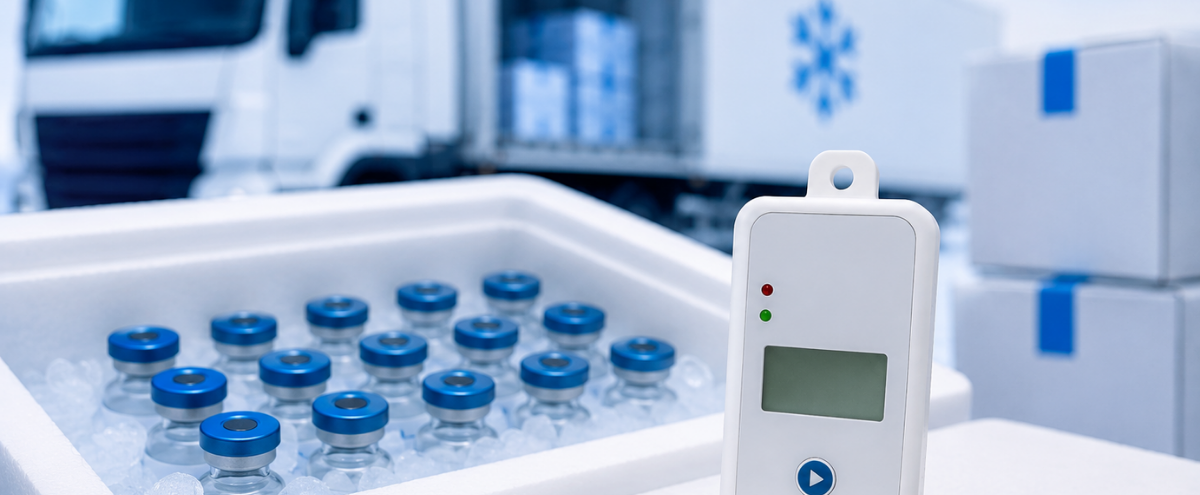
This guide shows you where loggers fit in healthcare and logistics, and how to pick and use the right one.
A fridge door that doesn’t latch can undo months of careful work. Nobody notices until Monday morning.
That’s the trouble with vaccines, biologics, and fresh freight. They live in narrow temperature ranges, and a box looks the same whether it stayed cold or not.
Did you know?
The CDC says every vaccine storage unit must have a temperature monitoring device. It names the digital data logger as the type that gives the most accurate readings, including how long a unit ran outside its range.
A digital temperature data logger gives you that proof. Let’s look at where healthcare and logistics teams use one.
A digital temperature data logger is a small, battery-powered device. It measures temperature at set intervals, called the recording interval, and saves each reading with a time stamp. Any reading outside the safe range is an excursion. You download the data later and use it as proof.
Let’s break down the terms you’ll hear. A temperature recording device keeps the history. A temperature monitoring system also sends alerts while a problem is happening.
Take Tempnote’s T32SU. It stores 32,000 readings, records every 10 seconds to 18 hours, and creates its own PDF and CSV report.
Clinics and pharmacies put a digital temperature logger in each vaccine fridge and freezer. The CDC warns that devices made for household food storage aren’t accurate enough for vaccines. It also lists devices without a current calibration certificate as limited, so ask for that paper when you buy.
These products cost a lot and often have short shelf lives. A full record protects the sender, the carrier, and the patient. If the data shows a spike on arrival, you can act fast.
Samples kept in dry ice or liquid nitrogen need loggers built for extreme cold. The DI-100 reads from -100°C to +100°C, and the Frigga V5J reaches -200°C.
Single-use loggers suit one-way flights because you don’t need the device back. The T32SU covers -30°C to +70°C. Tempnote lists Emirates, Lufthansa, and Qatar among the airlines that approve its loggers, but always check with your carrier before you ship.
Doors open at every stop, and the load warms a little each time. A digital temperature monitoring device inside the cargo shows which stop caused the spike.
Pick a logger rated for the lows you’ll see. For high-value loads, real-time loggers such as the Frigga series send instant alerts to a web page or mobile app, so you can act before the load is lost.
Here’s the thing: the best temperature data logger depends on what you ship.
| Type | Best for | Key trait | Examples |
|---|---|---|---|
| Single-use | One-way and air shipments | Disposable | T32SU, V1.0 |
| Multi-use | Repeat routes and fixed storage | Reusable | T32, TH32 |
| Dry ice / LN2 | Ultra-cold cargo | Built for extreme lows | DI-100, Tempod 200X |
| Real-time | High-value, time-critical loads | Live alerts | Frigga T70 Pro |
Compare four things: temperature range, accuracy, recording interval, and calibration paperwork.
Our take: for high-value biologics, don’t rely on a download-after-delivery logger alone. Reading data on arrival tells you what went wrong. A live alert lets you fix it. You can browse the full range under Cold Chain Monitoring Solutions.
Here’s a made-up but common case. A clinic’s vaccine fridge door doesn’t latch on Friday night. On Monday, the staff sees a warm reading.
With only a thermometer, they know it’s warm now. With a logger, they see when the temperature rose and how long it stayed out of range. What this really means is they decide with facts, not guesses.
Confirm the safe range, set the recording interval and alarm limits, and check the calibration certificate.
Start the logger and place it inside the load, away from cooling vents.
Stop the logger, download the report, and look for any excursion.
Review the data, not just the alarms. The Alabama Department of Public Health’s data logger guide says to download and review data weekly.
Marketing for a logistics or lab company in 2026? Start here.
Temperature problems are quiet. A digital temperature data logger makes them loud, and it gives you the data to act. Pick the type that fits your shipment, check the calibration, and review the readings every week.
Ready to choose? Talk to the Tempnote team about Cold Chain Monitoring Solutions for your products.
It records temperature over time so you can prove a product stayed in range.
A sensor measures temperature at set intervals, and the device stores each reading with a time stamp. You download the data for a report.
Single-use loggers are disposable and suit one-way shipments. Multi-use loggers are reusable, so they suit repeat routes and fixed storage.
For vaccine storage, the CDC lists devices without a current calibration certificate as limited. Ask for the certificate and track its expiration date.
One state health guide says to download and review data weekly, and to stop and check whenever an alarm sounds.
