Your cart is currently empty!


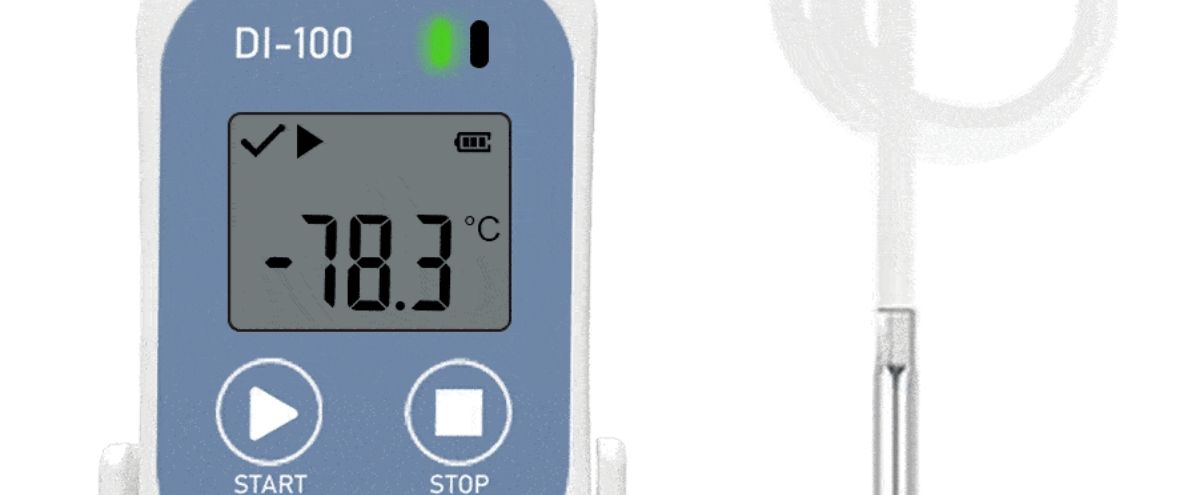
This guide explains how a Digital Dry ICE Temperature Data Logger records temperature during pharmaceutical shipments, which features matter most, and how the data can support quality and cold-chain processes.
A pharmaceutical shipment can arrive on time and still leave one important question unanswered: what temperature did the product experience during transit? This matters even more when medicines, biologics, vaccines, or clinical materials are shipped with dry ice.
A Digital Dry ICE Temperature Data Logger records temperature throughout the shipment, giving your team a clear record instead of relying only on the condition of the package when it arrives.
Did you know? USP says monitoring temperature during pharmaceutical storage and transportation is important because these conditions can affect drug stability. FDA guidance also recommends temperature-recording systems when qualifying cold-chain shipping containers, including insulated dry ice boxes.
In this guide, we explain how dry ice monitoring works, which features matter, and how recorded data can support your cold-chain process.
A Digital Dry ICE Temperature Data Logger is an electronic device that is used to capture and store temperature data for a given period of time. Instead of relying on a temperature check before shipping or after delivery, you get a record showing how conditions changed during transit.
Here’s the thing: dry ice creates an environment far colder than ordinary refrigerated shipping. Your monitoring device therefore needs a measurement range that matches the conditions it will actually face.
A Dry ICE temperature data logger can be used to record these readings at selected intervals. Depending on the device, you can later transfer the information to a computer and review the shipment record.
For pharmaceutical teams, this creates useful evidence for shipment review, quality checks, and excursion investigations.
It is essential to effectively monitor and provide evidence of conditions during the storage and transport of pharmaceuticals to ensure product stability.
These include:
Dry ice is solid carbon dioxide and is used to maintain very low temperatures during shipping. Your logger must therefore operate across an appropriate low-temperature range.
This is where cryogenic temperature monitoring and cold chain temperature monitoring become important. The exact monitoring requirement should always come from your product specifications and validated shipping process.
A temperature excursion does not automatically mean a product must be discarded. Instead, your quality team should review the recorded conditions against the product’s approved stability information and established procedures.
USP notes that temperature conditions during transportation can affect product stability and degradation.
Not every logger is designed for the same application. Before choosing a Digital temperature logger for dry ice, check these specifications.
| Feature | Why it matters |
|---|---|
| Temperature range | Must cover the expected shipping conditions |
| Accuracy | Helps you understand how close readings are to the actual temperature |
| Recording interval | Determines how often temperature is captured |
| Memory | Determines how many readings can be stored |
| Alarm settings | Helps flag readings outside selected limits |
| Reporting | Makes shipment records easier to review |
| Connectivity | Allows recorded data to be transferred |
| Validation documents | Supports your quality documentation process |
TempNote’s DI-100 can be used for validation of temperature logs during shipping. This logger is designed for temperatures ranging from -100°C to 100°C with an accuracy of +/-0.5°C from -80°C to 100°C and +/-1.0°C from -100°C to -80°C. It is able to log temperatures at a resolution of 0.1°C and stores up to 34,560 values. Recording intervals can be programmed from 18 hours down to 10 seconds.
It also provides user-configurable alarms, USB 2.0 connectivity, and self-generated PDF and CSV reports. The published specifications list CE, RoHS, and EN 12830 certifications, along with a validation certificate.
A temperature record is most useful when your team knows what to do with it.
Imagine a biotech company sends a temperature-sensitive material inside a dry ice container. The shipment reaches the laboratory on schedule, but the receiving team wants to confirm the conditions before accepting the shipment.
The logger report can show:
A published DI-100 sample report demonstrates these types of records, including minimum and maximum temperatures, the number of readings, trip length, alarm conditions, and periods of violation.
This gives your QA team actual temperature data to review rather than relying only on delivery time or the condition of the package.
FDA guidance also states that cold-chain shipping containers should be qualified with temperature-recording systems to verify that the intended product temperature is maintained under expected worst-case temperature and shipping-time conditions. The guidance specifically mentions insulated dry ice boxes as an example.
Your process should be simple and repeatable.
Step 1: Confirm the required range.
Check the pharmaceutical product’s approved storage and transportation requirements.
Step 2: Set the recording interval.
Choose an interval that gives your team enough data for the expected transit time and monitoring procedure.
Step 3: Configure Alarms
Alarm limits should be set based on your validated process. Do not use other arbitrary values.
Step 4: Position the Device
Follow your qualified and documented packaging and monitoring procedure.
Step 5: Review Logger Data
Upon receipt of the shipment, the logger data should be downloaded, and the shipment documentation should be retained.
The Dry Ice Shipment Temperature Logger you select should fit this complete process, not just the temperature range.
Upon delivery of the shipment, the condition of the logger should be documented and retained with other shipping documents. When choosing a dry ice shipment temperature logger, you should consider the entire process, from programmable temperature range to alarm limitations to data logging and reporting.
For example, the DI-100 is a multi-use dry ice logger with a −100°C to +100°C measurement range, USB data transfer, configurable recording intervals, and PDF/CSV reporting. Tempnote also lists it for applications including air and sea freight, freezer monitoring, distribution, and last-mile delivery.
Ask your team:
A reliable temperature record turns an uncertain shipping condition into measurable information. For pharmaceutical manufacturers, logistics providers, laboratories, and QA teams, that record can be an important part of reviewing cold-chain performance.
The best approach is to match your Digital Dry ICE Temperature Data Logger to your product requirements and validated shipping process before the shipment leaves your facility.
If your team regularly ships temperature-sensitive products with dry ice, review the specifications of the Tempnote DI-100 and see whether its temperature range, recording options, alarms, reporting, and documentation fit your monitoring requirements.
It is a device that measures and records temperature over time in very cold shipping environments. The stored readings provide a record that can be reviewed after transportation.
Temperature affects the stability of pharmaceuticals. Continuous monitoring of temperature during transport helps to collect data that could be evaluated against requirements and procedures to help ensure the quality of the pharmaceuticals.
The required range depends on the product and qualified shipping process. For example, the Tempnote DI-100 is specified from −100°C to +100°C.
No. It records the temperature conditions, but your qualified quality process must determine how an excursion affects the product.
The supported temperature range, accuracy, memory, minimum logging interval, alarms, methods of data output, communications, certifications, and validation should be considered.