Your cart is currently empty!


Our goal is to make it simple for you to understand the ways in which you can use an LN2 logger can help in ensuring that your monitoring is accurate, what influences can affect how accurate your measurements are, and what you need to think about prior to deciding on a suitable facility.
Key Takeaways
| What to check | Why it matters |
|---|---|
| Temperature range | Must suit your actual cryogenic conditions |
| Accuracy | Shows how close readings are expected to be to the measured value |
| Resolution | Shows smaller temperature changes |
| Sensor placement | Helps ensure the reading represents the condition you actually want to monitor |
| Calibration | Supports reliable and traceable measurements |
| Alarms | Helps flag abnormal readings |
| Data records | Give you a temperature history for review and QA |
The use of liquid nitrogen storage allows laboratories, biobanks, IVF clinics, pharmaceutical facilities, and research centers to preserve sensitive materials at extremely low temperatures. But keeping an LN2 tank cold is not enough. You also need reliable temperature records that show what happened between routine checks.
This is where an Ultra Low Temperature Logger comes in. It records temperature at predetermined intervals and allows you to spot odd changes over time, not just from the odd manual check.
Did you know?
The National Institutes of Health states that liquid nitrogen is maintained at about −196°C (−320°F) when used in tanks or freezers for maintaining samples in a cryogenic condition.
The use of liquid nitrogen in the preservation of cells, tissues, embryos, sperm, and other biological materials is common. It provides very low temperatures for cryogenic storage, approximately 196°C.
The problem is that LN2 levels can fall because of normal evaporation, delayed refilling, insulation problems, or tank failure. Research on cryostorage tanks shows that loss of LN2 can cause stored samples to warm and, in serious cases, result in sample loss.
A single manual reading cannot tell you what happened between inspections. Continuous liquid nitrogen temperature monitoring gives you a much clearer record.
An LN2 Temperature Logger uses a temperature sensor designed for the required low-temperature range. The sensor records readings according to the logging interval you select.
Here’s the thing: a wide measurement range alone does not prove that a logger is suitable. You should look at three separate specifications: measurement range, accuracy, and resolution.
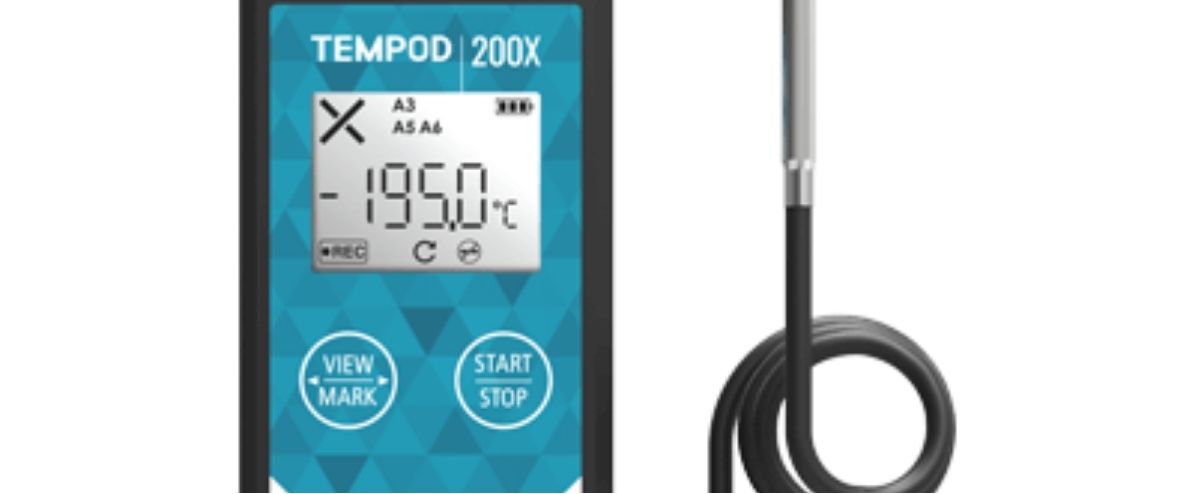
For example, the Tempod 200X is specified for −200°C to +70°C, with 0.1°C resolution. Tempnote states an accuracy of ±1.0°C for the range outside −100°C to +70°C and ±0.5°C from −100°C to +70°C.
Because LN2 is around −196°C, the relevant accuracy specification for an LN2 application is the ±1.0°C specification, not the ±0.5°C specification. This is an important detail to check when comparing an ultra-low-temperature data logger.
A suitable sensor is only part of accurate monitoring. Where and how you position it also matters. The sensor should be installed according to the monitoring objective, equipment design, and manufacturer instructions so that the recorded temperature represents the condition you actually need to track.
NIST research has found that proper data logger setup and sensor placement are important to obtaining measurements that represent the stored material or environment.
A temperature number is only useful when you have confidence in how it was measured.
Calibration compares an instrument against known reference points. NIST explains that metrological traceability requires an unbroken documented chain of calibrations leading to specified reference standards.
For your facility, check whether the logger comes with documented calibration and whether the calibration approach fits your quality requirements.
NIST research also shows why calibration stability and periodic verification matter when data loggers are used for continuous monitoring.
Tempnote’s Tempod 200X specifies factory NIST-traceable 3-point calibration.
Suppose your laboratory checks an LN2 tank at 9 a.m. and finds a normal reading. That tells you the condition at 9 a.m. It does not tell you what happened at midnight.
An Ultra Low Temperature Logger records readings throughout the selected monitoring period. You can then review:
Tempod 200X supports logging intervals from 1 minute to 2 hours and stores up to 28,800 values. It also provides high and low alarm ranges.
The right interval depends on your SOP, storage system, and risk level. More frequent recording gives you more detail, but it also uses memory faster.
For pharmaceutical, biotech, clinical, and research facilities, monitoring does not end when the temperature is recorded. You may also need to show what was recorded, when it was recorded, and whether the data can be reviewed later.
This is why digital records can be more useful than handwritten checks. NIST research has shown that proper logger setup, validation, stability, and traceability all matter when building reliable temperature monitoring practices.
Tempod 200X provides encrypted PDF reports with embedded raw data and uses TempCentre2 software listed by the manufacturer as 21 CFR Part 11 compliant.
Before choosing an LN2 Data Logger, use this checklist:
| Check | Question to ask |
|---|---|
| Temperature range | Does it cover your required temperature range? |
| Accuracy | What accuracy is specified at your actual operating temperature? |
| Resolution | Can it record the temperature changes that matter to you? |
| Sensor Placement | Is the probe designed for the intended cryogenic application? |
| Placement | Will the sensor location represent the condition you need to monitor? |
| Calibration | Is calibration documented and traceable? |
| Alarms | Can you set high and low limits? |
| Memory | Can it store enough readings for your monitoring period? |
| Reporting | Can you export records in a format your team can use? |
| Quality system | Does it fit your SOP, validation, and recordkeeping needs? |
Do not select a logger simply because its lowest advertised temperature looks impressive. For example, if your application is near −196°C, you should check the accuracy specification that applies at that temperature rather than relying only on a −200°C headline range.
Reliable ultra-low temperature monitoring is about more than seeing a number on a screen. You need accurate measurement, suitable calibration, useful logging intervals, alarms, and records that your team can review when something goes wrong.
An Ultra Low Temperature Logger can give your laboratory a continuous temperature history instead of isolated manual readings. For facilities managing valuable cryogenic materials, that extra information can make it easier to spot problems, investigate excursions, and support your quality process.
If you’re comparing cryogenic monitoring options, read the LN2 Temperature Logger specifications from Tempnote and compare the range of measurement and accuracy, as well as calibration alarms, memory, and reporting options, against your own needs.
Ready to improve your cryogenic monitoring?
Tempnote’s LN2 monitoring system and evaluate its specifications against your facility’s temperature and alarm requirements, calibration, and reporting requirements.
An LN2 temperature logger tracks the temperature of cryogenic storage and liquid nitrogen to allow you to review temperatures over time.
It allows you to identify fluctuations in temperature that may signal LN2 depletion, storage issues, or other problems that require attention.
Not necessarily. It is essential to verify that the logger and the sensor are certified for the necessary temperatures in the cryogenic range.
There is no single interval for every application. Your monitoring interval should match your SOP, risk level, storage system, and data requirements.
Temperature range, accuracy, resolution, sensor suitability, calibration, alarms, memory, battery life, and data reporting capabilities are the most important considerations.