Your cart is currently empty!


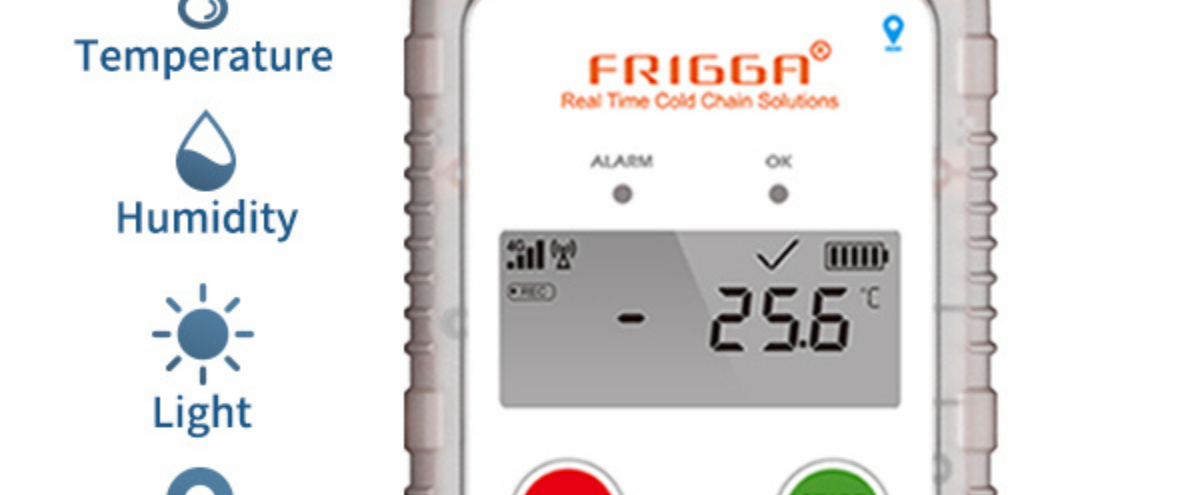
Our goal is to explain where a Frigga V5D Temperature Data Logger can be useful and how its monitoring, alerts, tracking, and reporting features support temperature-sensitive shipments.
A temperature-sensitive shipment can arrive on time and still be a problem if its temperature went outside the required range during transit. That is why reliable monitoring matters across pharmaceutical, food, dairy, and cold-chain logistics operations.
The Frigga V5D is a single-use, real-time temperature data logger to record shipping conditions and provide cloud-based monitoring. The measurement range is -20°C to +70°C with a ±0.5°C accuracy and 0.1°C resolution, along with high and low alarms and a 60-day runtime.
A temperature data logger records temperature at set intervals so you can review conditions during storage or transportation. A real-time monitoring device goes one step further by sending shipment data to a remote platform.
The Frigga V5D temperature recorder is designed for single-use shipments. It records temperature at a customizable interval, with 10 minutes listed as the standard setting on the product page. It stores up to 28,800 values and provides PDF reports through USB 2.0 or the cloud platform.
GPS tracking, temperature monitoring, alerts, historical graphs, battery information, and live GPS tracking are also included in the cloud system.
Pharmaceutical manufacturers, distributors, vaccine suppliers, biologics companies, and clinical-trial logistics teams need clear records of transport conditions.
A Frigga V5D can record temperature throughout a shipment and flag high or low readings through its alarm settings.
If a shipment arrives with a suspected temperature issue, the recorded data can help your quality team review what happened rather than relying only on the final delivery condition.
WHO states that temperature monitoring is an important part of maintaining suitable pharmaceutical storage conditions, while its temperature-monitoring category includes data loggers, temperature recorders, alarms, and remote monitoring systems.
Food manufacturers, distributors, and dairy businesses also need dependable temperature records because transport conditions can affect product quality.
| Industry | Practical Use | Useful Information |
|---|---|---|
| Pharmaceuticals | Medicine shipments | Temperature history and alerts |
| Vaccines & biologics | Sensitive product transit | Temperature records and shipment tracking |
| Food | Perishable goods | Temperature changes during transit |
| Dairy | Chilled products | High/low temperature monitoring |
| Logistics | Refrigerated cargo | Location, temperature, alerts, reports |
For example, if a refrigerated dairy shipment experiences an unexpected temperature rise, an alert can give your team an opportunity to investigate while the shipment is still moving. The logger does not prevent the temperature change, but it can help your team identify it.
For logistics teams, visibility is often as important as the final temperature report.
The Frigga V5D cold chain monitoring setup combines temperature information with cloud-based shipment tracking. Its platform provides live GPS tracking, temperature data, alerts, historical graphs, and reporting.
This can be useful for:
Here’s the practical point: your team can review a temperature deviation with its shipment data instead of waiting until delivery to see the full record.
Features listed on the product page that deal with transport monitoring include a temperature range of -20°C to +70°C, an accuracy of ±0.5°C, a resolution of 0.1°C, a runtime of 60 days, 2G cellular communication, high and low alarms, USB 2.0, and PDF reporting. It also lists EN 12830 and 21 CFR Part 11 compliance.
One important point for regulated businesses: a device being listed as 21 CFR Part 11 compliant does not by itself make an entire company’s process compliant. FDA explains that Part 11 applies to certain electronic records and signatures maintained or submitted under applicable requirements. Your own procedures and record controls still matter.
Before shipping:
Step 1: Determine the required transport temperature of the product.
Step 2: Configure a device to record and alert according to the approved procedure.
Step 3: Start the device before shipping to confirm that monitoring is initiated.
Step 4: Take necessary actions during shipment by reviewing alarms that are sent to you.
Step 5: Save the final report in PDF or CSV format with your shipping records.
This simple process gives your team a clear record from dispatch through delivery.
Temperature monitoring is not just about collecting numbers. It provides evidence of the transport conditions and supports your team in initiating actions that can help in avoiding further unwanted effects.
Your specific product, transportation duration, reporting, and quality control needs must be considered to find the best USB temperature logger or real-time temperature monitoring device for your pharmaceutical, food, dairy, or logistics operations.
Check out the Frigga V5D Data Logger provided by Tempnote if you are looking for a logger that provides real-time shipment visibility with temperature alerts, GPS tracking, and downloadable reports. Assess whether the specs work for you and your cold chain logistics operation.
It is a single-use temperature data logger designed to monitor temperature-sensitive shipments and provide real-time cloud monitoring, alerts, tracking, and reports.
The page for the product provides a measurement range of -20°C to +70°C and +-0.5degC precision across the stated range.
Yes. The temperature recording, as well as alerts, tracking, and reporting capabilities, can be used to support pharmaceutical cold chain transportation if used in accordance with your product’s quality specifications.
Yes. Its cloud platform provides real-time temperature monitoring, live GPS tracking, alerts, historical graphs, and shipment information.
Yes. Reports can be obtained through USB 2.0 or the cloud platform, with PDF reporting listed by the manufacturer.