Your cart is currently empty!


Objective
Our goal is to provide insight into how a Pallet Thermal Blanket protects temperature-sensitive shipments and what to consider when selecting one to protect shipments in the pharmaceutical and food industries.
Key Takeaways
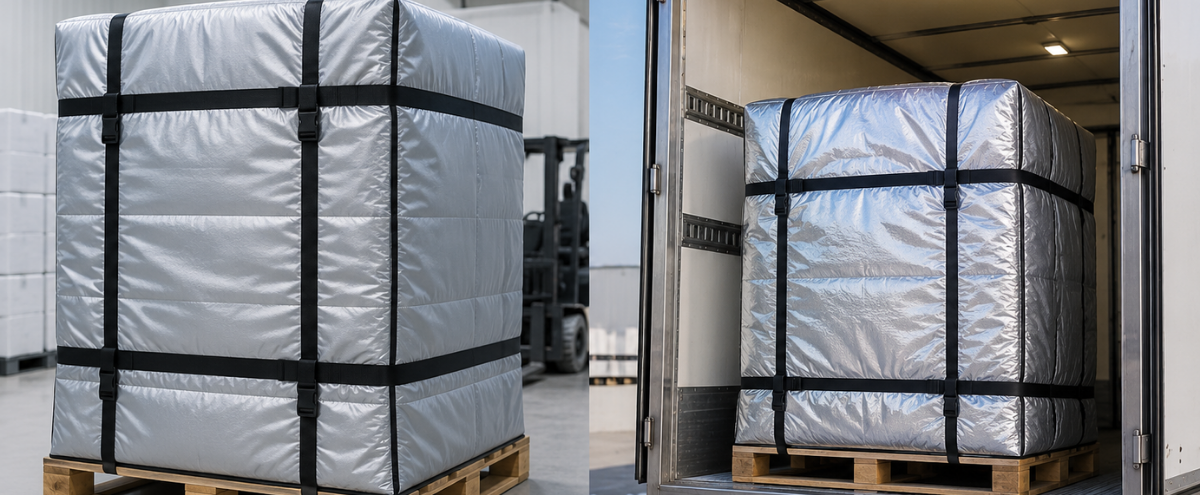
A pallet can leave a temperature-controlled facility in perfect condition and still face heat or cold during loading, airport handling, cross-docking, or road transportation. For businesses shipping temperature-sensitive products, these short exposure periods can matter. This is especially important for the transport of pharmaceuticals, as these products are regulated based on the required storage and transport conditions. The appropriate thermal blanket for pallets will provide the necessary protection for the pharmaceuticals from the effects of extreme temperatures during transit and from the many different handling processes. The Insupod thermal covers from Tempnote are made of reflective and insulating materials and are available for specific target temperatures of 2°C–8°C and 15°C–25°C.
Did you know? WHO guidance identifies temperature mapping and monitoring as important parts of appropriate pharmaceutical storage conditions. This shows why thermal protection should work alongside proper temperature monitoring rather than replace it.
A Thermal Blanket for Pallets mitigates temperature variances that palletized products are subjected to during transport and handling. It does not refrigerate or heat; it simply creates a passive thermal barrier.
A Pallet Thermal Blanket can be useful when your shipment moves between controlled environments, such as from a refrigerated warehouse to a truck, loading area, airport, or distribution center.
The materials and construction matter. Tempnote lists its Insupod covers with an aluminum bubble and aluminum foil construction, with reflective surfaces designed to reduce external thermal exposure.
Pharmaceutical transportation requires careful temperature control. WHO guidance covers the safe storage and distribution of time- and temperature-sensitive pharmaceutical products and stresses suitable transport practices and qualified packaging.
WHO also states that temperature mapping and monitoring are integral to appropriate pharmaceutical storage conditions.
Food shipments also need proper temperature management. USDA guidance says perishable foods should generally be kept at 40°F or below, while bacteria can grow rapidly between 40°F and 140°F.
Here’s the thing: a thermal cover is only one part of the system. Your refrigeration, packaging, handling process, and temperature monitoring still need to match the product.
Before buying an Affordable Insulated Pallet Cover, check these five factors:
| What to Check | Why It Matters |
|---|---|
| Temperature range | Your cover must suit the product requirement |
| Transit time | Longer exposure may require a different solution |
| Insulation | Helps reduce the effect of outside conditions |
| Pallet size | A proper fit helps provide effective coverage |
| Reusability | Useful for regular shipping operations |
You should also consider the route. A pallet moving directly from a cold warehouse into a refrigerated truck has different needs from one waiting on a loading dock or passing through an airport.
Tempnote lists Insupod TC500 and TC500DBB covers at 8 mm and 20 mm thickness, respectively. Both are listed with 97% reflectivity, Euro/ISO pallet sizes, bespoke solutions, foldable and stackable operation, and applications covering 2°C–8°C and 15°C–25°C. The listed protection is 8+ hours.
These are product specifications from Tempnote, so your own shipment requirements should determine which configuration is appropriate.
For pharmaceutical transportation, start with the product’s required temperature range. Medicines are not all stored or transported under the same conditions. WHO materials identify pharmaceutical requirements that can include ranges such as 2°C–8°C and 15°C–25°C.
For temperature-controlled food products, special consideration should be made for dairy, seafood, meat, and other food products that are perishable and may require constant temperature control.
Imagine a pharmaceutical pallet leaving a temperature-controlled warehouse on a hot day. The truck may be ready, but the pallet could spend time waiting at the dock. A Thermal Pallet Cover can provide an added passive barrier during that exposure.
At the same time, a temperature logger can record conditions during transit. This gives your team useful shipment data instead of relying only on assumptions.
The best Thermal Covers for Pallets are not selected by thickness alone. You need to consider the product, required temperature range, route, exposure time, pallet size, and complete cold-chain process.
For businesses handling pharmaceutical or food shipments, Tempnote’s Insupod range provides listed options for specific temperature applications, pallet sizes, and operating needs.
If you are looking for a Pallet Thermal Blanket, review your shipment requirements first and then choose the cover that fits your process.
Once a pallet has left the warehouse, it is not going to stop experiencing thermal exposure. The right Thermal Blanket for Pallets provides an added layer of protection for those time-sensitive situations.
Are you ready to evaluate how you protect your pallets?
Check out Tempnote’s Insupod thermal covers and see the various options for your pharmaceutical, food, or cold-chain shipment offerings.
Thermal Blanket for Pallets is a passive protective cover to help reduce exposure to external temperature changes during transport and handling.
Can be suitable for pharmaceuticals cold-chain operations if the cover is appropriate to the product’s temperature requirement and it is used with suitable packaging and monitoring.
Tempnote lists its Insupod TC500 and TC500DBB covers for 2°C–8°C and 15°C–25°C applications, with listed protection of 8+ hours.
Yes. While they can offer some passive insulation from outside temperatures, they should be combined with appropriate refrigeration packaging handling and monitoring.
Check your product’s required temperature range, transit time, pallet dimensions, insulation, reflectivity, operating conditions, and reuse requirements before selecting a cover.