Your cart is currently empty!


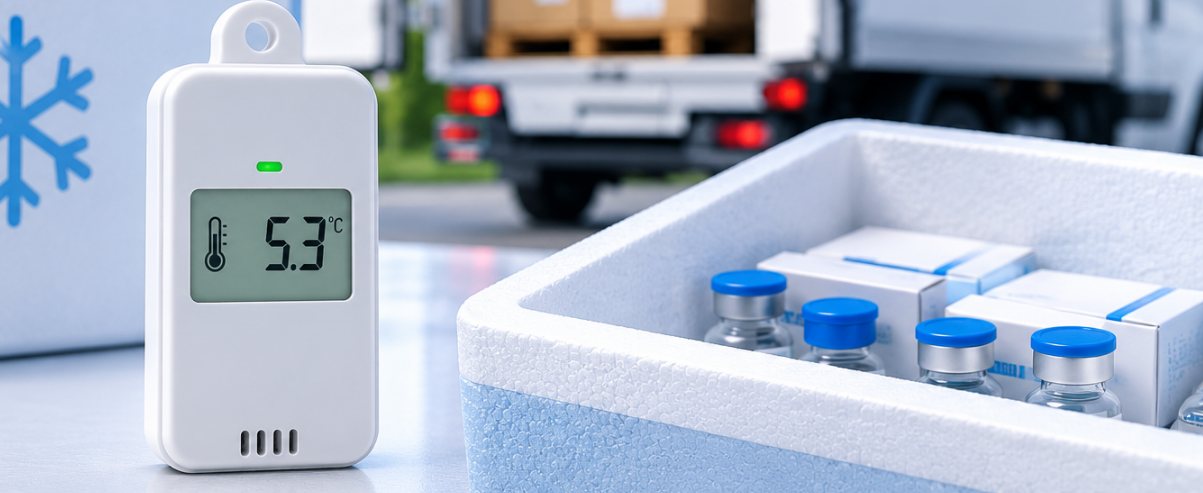
This blog explains the ways a Best temperature data logger will help reduce risk, stay within GDP and FDA regulations, and also save cash across food, pharmaceutical, and life science cold chains. It also explains how the best format for loggers will work for your specific workflow.
A single unnoticed temperature spike can destroy a $50,000 pharmaceutical shipment before it ever reaches a patient. Here’s the thing: most cold chain failures are invisible until you open the box at delivery. By then, your product, your compliance record, and your customer trust are already damaged.
A modern temperature data logger changes the game. It doesn’t just record data; it gives you real-time visibility, automated proof of compliance, and the power to stop spoilage before it starts.
Table of Contents
Let’s break it down. A temperature data logger is a compact device that automatically records temperature at set intervals. Some store data for later download. Others, like a wireless temperature data logger, transmit readings in real time so you can act the moment something goes wrong.
Manual checks are no longer enough. Human error creeps into handwritten logs. Readings get missed on weekends. The CDC has made it clear that failure to stick to recommended storage specs can reduce or destroy vaccine potency. Automated loggers remove that guesswork.
Who needs this most? QA managers need tamper-proof audit trails. Supply chain directors need end-to-end visibility. Operations managers want fewer fire drills. Procurement managers need clear ROI. A digital temperature data logger serves all of you.
A wireless temperature data logger sends data continuously via cellular or Wi-Fi. The moment temperatures drift outside your set range, you get an alert. Old-school loggers only tell you about a problem after delivery, when your product is already ruined.
What this really means is simple. Real-time temperature monitoring turns reactive damage control into proactive risk management.
Here’s a real example. A pharma exporter in Mumbai ships insulin to the Middle East. Mid-flight, cargo hold temperatures drift. The wireless logger triggers an instant alert. The freight forwarder adjusts the cooling unit during the layover. The product arrives intact. The audit trail is automatic.
Good Distribution Practice (GDP) and FDA regulations require documented proof of constant temperature control. Manual logs take time to create and are difficult to contest. A digital temperature data logger automatically generates timestamped, tamper-proof documents that auditors are able to trust.
The Tempnote platform can export documents that conform to the requirements of PDF, which include charts, excursion flags, and serial numbers of devices. When you use FDA 21 CFR Part 11-compliant software, you’ll be able to defend against fines imposed by regulatory authorities as well as rejection of your product.
For a stress-free audit, you need continuous data, calibration certificates, user-access logs, and secure cloud storage. Think of your temperature data logger as insurance, not an expense.
Cold chain integrity doesn’t start on the truck. It starts in your medical refrigerator monitoring setup. Stationary or probe-style loggers verify that vaccines and blood samples stay within 2–8°C or -20°C ranges. For ultra-cold storage like dry ice, TempNote’s DI-100 probe logger handles temperatures down to -80°C.
Each transport mode carries its own risks. Tarmac delays hit air cargo. Reefer units fail on the road. IATA-approved loggers are built to handle the pressure and vibration of air freight. Look for RTCA-DO160G certification when you buy.
Now let’s talk about cloud temperature monitoring. This is the central nervous system of your cold chain. All logger data feeds into one web interface or mobile app. You can view every active shipment, filter by route, and share live links with customers.
Not every shipment needs the same tool. Let’s look at your options.
| Logger Type | Best For | Connectivity | Report Method | Key Certifications |
|---|---|---|---|---|
| USB Temperature Data Logger | Short-haul, budget ops | Offline | USB download / PDF | EN12830, CE, Airline Approved |
| Wireless Temperature Data Logger | High-value, long-haul | Cellular / Wi-Fi | Cloud + instant alerts | IATA, RTCA-DO160G, Airline Approved |
| Digital Temperature Data Logger (Probe) | Ultra-cold, medical fridge | Wired probe | USB / Cloud | CE, GDP-compliant |
| Single-Use Logger | One-way, Export international | Offline | USB download | EN12830, CE, Airline Approved |
A USB temperature data logger for cold chain is cost-effective and plug-and-play. A wireless model costs more upfront but pays for itself when early intervention saves a high-value load. Single-use loggers work best when return logistics are impractical.
Here’s the math. Take the value of one at-risk shipment and divide it by your annual logger cost. Most operations break even after preventing just one excursion per year. That doesn’t even count the brand reputation you protect.
As you scale, you cannot manage fifty shipments in fifty separate spreadsheets. Cloud temperature monitoring pulls every device, warehouse, and transport temperature monitoring leg into one system. You can grant role-based access to QA, logistics, and customers without emailing files.
Modern cold chain visibility is about integration, not isolated gadgets. API connectivity and data exports in CSV or PDF feed directly into your ERP or WMS platforms.
How do you avoid alert fatigue? Configure tiered alerts. Set a warning at 7°C and a critical alert at 8°C for a 2–8°C product. Cloud analytics also help you spot patterns; maybe one carrier runs hot repeatedly, so you fix the root cause instead of fighting the same fire twice.
Cold chain failures are expensive, but they are also preventable. A temperature data logger gives you the real-time alerts, compliance documentation, and operational clarity you need to protect your products and your reputation. Whether you need medical refrigerator monitoring at your facility or transport temperature monitoring across continents, the right logger setup pays for itself.
Every shipment you send without a temperature data logger is a risk to your product, your compliance, and your customer relationships. Whether you need a USB temperature data logger for local routes, a wireless temperature data logger for international pharma shipments, or full cloud temperature monitoring across your entire network, we have a solution built for your workflow.
Book a 15-minute consultation with our team, and we’ll show you exactly how Tempnote’s IATA-approved, GDP-compliant loggers fit your operation- no generic pitches, just a plan that works for your cold chain.
Q1: What is the difference between a USB temperature data logger and a wireless one?
The USB logger is able to store information that can be downloaded at the end of the journey, and the wireless temperature data logger transmits information in real-time via Wi-Fi or cell phones and permits instant intervention during the middle of the journey.
Q2: How does real-time temperature monitoring prevent cold chain failures?
The product will inform you by email when temperatures go beyond the specified temperature range, to allow you to resolve the issue before the item becomes damaged.
Q3: Is a digital temperature data logger required for GDP and FDA compliance?
Although it’s not required, regulators do require a continuous, exact, precise, and secure record of temperature. A digital temperature information recorder can be the best method to produce the audit trails that GDP as well as FDA 21 CFR Part 11 require.
Q4: Can one system handle both medical refrigerator monitoring and transport temperature monitoring?
Yes. Modern platforms combine stationary loggers for medical refrigerator monitoring with mobile loggers for transport temperature monitoring, feeding all data into one cloud temperature monitoring dashboard.
Q5: What is cloud temperature monitoring, and do small operations really need it?
Cloud temperature monitoring stores and analyses the logs on a safe web-based platform. Even small-scale operations can benefit since it makes record-keeping easier, which makes audits easier and gives customers proof of the integrity of delivery.